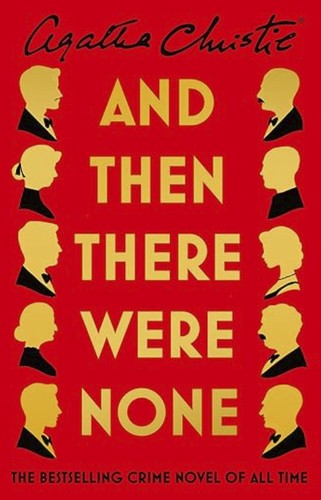
How it was received Widely praised on release for its ingenious plotting, the novel became Christie's best-selling work and the world's best-selling mystery, with over 100 million copies sold. It was later ranked 19th by the Crime Writers' Association and 10th by the Mystery Writers of America on lists of top crime novels, and voted the World's Favourite Christie in 2015. — Wikipedia
Ending signals — verified, spoiler-light. Tap a question to see only that answer.
Is the ending happy?
TragicDoes it end on a cliffhanger?
NoIs the romance resolved?
No central romanceDo major characters die?
YesHow does And Then There Were None end?
The deaths continue to follow the order of the nursery rhyme until all ten people on the island are dead. After Justice Wargrave is found apparently shot in his judge's robes, the survivors believe he has been murdered like the rest. Armstrong then vanishes in the night, and the next day Blore is crushed by a marble clock thrown from Vera's window, and Armstrong's drowned body washes up on the beach, seemingly leaving Vera Claythorne and Philip Lombard as the last two survivors. Vera tricks Lombard, seizes his revolver, and shoots him dead. She goes up to her room to find a noose and a chair already prepared, and in a haze of guilt and delusion, believing her dead former fiancé is present, she hangs herself, fulfilling the final line of the rhyme.
When investigators from Scotland Yard reach the island, they find ten corpses and no killer. Piecing together diary entries, they can account for six of the deaths but are baffled by the final four, since objects were moved and actions taken after Armstrong, Lombard, and Vera were supposedly dead, and Blore's death looks like murder rather than accident. The case appears unsolvable.
The truth surfaces later through a confession sealed in a bottle and recovered from the sea by fishermen. It was written by Mr Justice Wargrave, the retired judge, who reveals that he orchestrated everything. Driven since childhood by both a passion for justice and a hidden lust to kill, Wargrave had spent his career sentencing the guilty to death but craved to be the one who killed directly. He identified ten people who had each caused a death but escaped legal punishment, and lured them to the island under the guise of Mr and Mrs U.N. Owen. He hired a shady agent, Isaac Morris, to make the arrangements and then made sure Morris died of a barbiturate overdose so there would be no loose ends.
Wargrave killed his victims one by one according to the rhyme, manipulating the trusting Dr Armstrong into helping him fake his own death as part of a supposed plan to unmask the murderer among the survivors, then killed Armstrong once he was no longer needed. After the others were dead, Wargrave staged his own death using an elastic cord to make it look as though he'd been shot earlier, then, once alone, shot himself for real, timing it so his actual death matched the account already recorded in the survivors' diaries. His confession closes with his own grim epitaph for the case: ten dead bodies and an unsolved problem, since without his letter the deaths would have remained a permanent mystery.
✓ Fact-verified against independent sources
Reception summary adapted from Wikipedia, CC BY-SA 4.0.