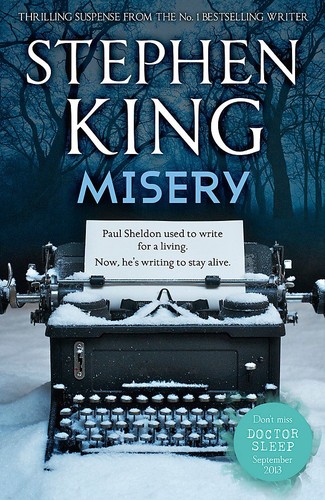
How it was received Misery won the inaugural Bram Stoker Award for Best Novel in 1987 and earned a World Fantasy Award nomination, while reaching number four on the New York Times bestseller list. Reviews were largely positive, with The Guardian calling it one of the greatest thrillers ever written and Kirkus Reviews praising its dark humor and leanness. — Wikipedia
Ending signals — verified, spoiler-light. Tap a question to see only that answer.
Is the ending happy?
BittersweetDoes it end on a cliffhanger?
NoIs the romance resolved?
No central romanceDo major characters die?
YesHow does Misery end?
The climax arrives after Annie Wilkes has already mutilated Paul Sheldon repeatedly, cutting off his foot with an axe and later his thumb, all while he is forced to write Misery's Return, a novel resurrecting the heroine she loves. A state trooper, Duane Kushner, tracks Paul's trail to Annie's isolated house. When Paul tries to signal him, Annie murders the officer by running him down with her riding lawnmower. She then decides that once the manuscript is finished, she will shoot Paul and then herself.
While Annie is occupied disposing of Kushner's body, Paul steals lighter fluid and sets fire to what appears to be his completed manuscript, provoking Annie into a desperate attempt to save it. In the chaos, Paul attacks her with the heavy Royal typewriter she gave him, and the two fight violently. Paul manages to get word out and the police, already searching for their missing trooper, arrive at the house. Annie is found dead of her injuries in the barn, apparently on her way to kill Paul with a chainsaw. Only afterward is it revealed that the manuscript Paul burned was a decoy; the real copy of Misery's Return survives intact.
Paul returns home to New York a broken man physically and psychologically. He submits Misery's Return to his publisher, and the novel goes on to become an international bestseller, cementing the character's legacy even as Paul longs to leave her behind. He is left with a permanent limp, missing digits, recurring nightmares about Annie, ongoing withdrawal from the painkillers she fed him, and a new dependence on alcohol, along with a paralyzing writer's block.
The novel closes on a note of fragile hope: after a chance encounter on a New York street, something in Paul is unlocked, and he finds himself able to write again. The final image is of him weeping simultaneously for the ruin Annie made of his life and with relief and joy that his creative voice has returned.
✓ Fact-verified against independent sources
Does the film end like the book? — Misery (1990)
No — the film changes the ending.
Misery · 1990 · film · dir. Rob Reiner
Everyone remembers the hobbling, and the film is the merciful version. King has Annie take Paul's foot off with an axe and cauterise the stump with a blowtorch, then cut off his thumb with an electric knife when he complains about the typewriter. Reiner's Annie breaks both ankles with a sledgehammer — appalling, and survivable in a way an axe is not.
The endgame differs too. The novel's Annie kills the state trooper who comes looking for Paul by running him over with her riding lawnmower; the film's shoots the local sheriff. Paul escapes on the same trick either way — burn the manuscript, swing the typewriter — but King lets him win twice, because the pages he burns are a decoy and the real Misery's Return survives to become a bestseller. King's Annie is found dead in the barn, on her way back to him with a chainsaw; Reiner's dies in the room, hit in the face with an iron doorstop. And the film adds one last turn of the knife: eighteen months on, in a New York restaurant, a waitress comes over, and for a moment she is Annie, telling him she is his number one fan.
✓ Every claim checked against the plot summaries of both the book and the film — Wikipedia
Reception summary adapted from Wikipedia, CC BY-SA 4.0.