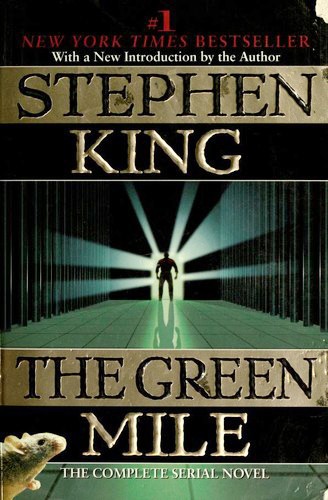
How it was received The novel won the 1996 Bram Stoker Award for Best Novel and was a 1997 nominee for both the British Fantasy Award and the Locus Award, later appearing on the BBC's 2003 Big Read poll of best-loved novels; its film adaptation was also a critical and commercial success. — Wikipedia
Ending signals — verified, spoiler-light. Tap a question to see only that answer.
Is the ending happy?
BittersweetDoes it end on a cliffhanger?
NoIs the romance resolved?
No central romanceDo major characters die?
YesHow does The Green Mile end?
John Coffey's execution closes out the central story. Once Paul Edgecombe learns the truth—that it was William "Wild Bill" Wharton, not John, who raped and murdered the Detterick twins, and that John had actually been trying to bring the girls back to life when he was found holding their bodies—Paul is left in an agonizing position. He knows John is innocent, but there is no realistic way to stop the execution or clear his name. When Paul tries to talk to John about escape or delay, John tells him not to worry: he is tired of the pain and ugliness he feels from other people's minds and is ready to die. Paul, along with the other death row guards Brutus Howell, Dean Stanton, and Harry Terwilliger, walks John through his final hours and puts him to death in the electric chair. It is the last execution Paul ever takes part in.
The events leading up to this are set in motion by Percy Wetmore, a cruel and self-important guard connected to the governor by marriage, who deliberately sabotages Eduard Delacroix's execution by leaving the sponge dry, causing Del to catch fire and die in prolonged agony. Before that, the guards had already discovered John's healing power when he cures Paul's urinary infection and revives Del's pet mouse, Mr. Jingles, after Percy stomps it to death. Later, Paul and the others smuggle John out to secretly heal Warden Hal Moores's wife, Melinda, of a fatal brain tumor. John absorbs her illness into himself in visible, painful form, and then, on returning to the prison, expels that sickness into Percy by grabbing him. This drives Percy into a psychotic break in which he shoots Wharton dead before lapsing into a permanent catatonic state; he is committed to Briar Ridge, the psychiatric hospital he'd once hoped to work at.
After John's execution, the novel returns to its 1996 framing device, in which an elderly Paul, living at the Georgia Pines nursing home, has been writing down this entire account. He explains a further consequence of contact with John's power: those he healed, including Paul himself and Mr. Jingles, were granted greatly extended lifespans. Paul finally shows the finished manuscript to his close friend and fellow resident, Elaine Connelly, and afterward reveals Mr. Jingles to her, the same mouse from 1932, still alive some sixty-four years later.
Soon after, Elaine dies, never knowing that on the day of her death Paul glimpsed what he believed was the ghost of John Coffey. The book ends with Paul, now 104 years old and essentially alone, reflecting on the unnatural longevity he was given and wondering, with unease rather than comfort, how much longer he is fated to go on living.
✓ Fact-verified against independent sources
Does the film end like the book? — The Green Mile (1999)
Yes — the film keeps the book’s ending.
The Green Mile · 1999 · film · dir. Frank Darabont
Darabont keeps the ending down to the arithmetic of the miracle. John Coffey chooses to die — worn out by feeling what people do to each other — and Paul, who is sure he is innocent and cannot prove it, walks him to the chair anyway. Decades on, Paul is impossibly old, Mr. Jingles is impossibly old, and Elaine is stunned by the mouse.
Two things are staged differently. The novel has John simply discharge Melinda's disease into Percy; the film makes it visible, John forcing a swarm of flies into Percy's mouth before a possessed Percy shoots Wharton. And the film gives John a last request the book does not: having never seen a movie, he asks to watch one, so the guards sit through Top Hat with him. The film also ages Paul four more years — 108 in 1999 rather than 104 — and gives him a harder reading of his own long life: not a gift but a punishment for letting John die.
✓ Every claim checked against the plot summaries of both the book and the film — Wikipedia
Reception summary adapted from Wikipedia, CC BY-SA 4.0.